Table of Contents
Ask almost any student how they prepare for upcoming tests, and they will likely describe a familiar routine: sitting at a desk with highlighter pens in hand, reading textbook chapters three or four times, and skimming through lecture summaries. It feels industrious, comfortable, and reassuring.
Yet decades of cognitive psychology research point to a startling conclusion: passive re-reading and highlighting are among the least effective study strategies available.
When you re-read familiar paragraphs, your brain confuses visual recognition with actual comprehension—a cognitive trap known as the illusion of competence. You feel as though you know the material because the text looks familiar on the page, but the moment you sit down in an exam hall facing a blank question sheet, that familiarity vanishes.
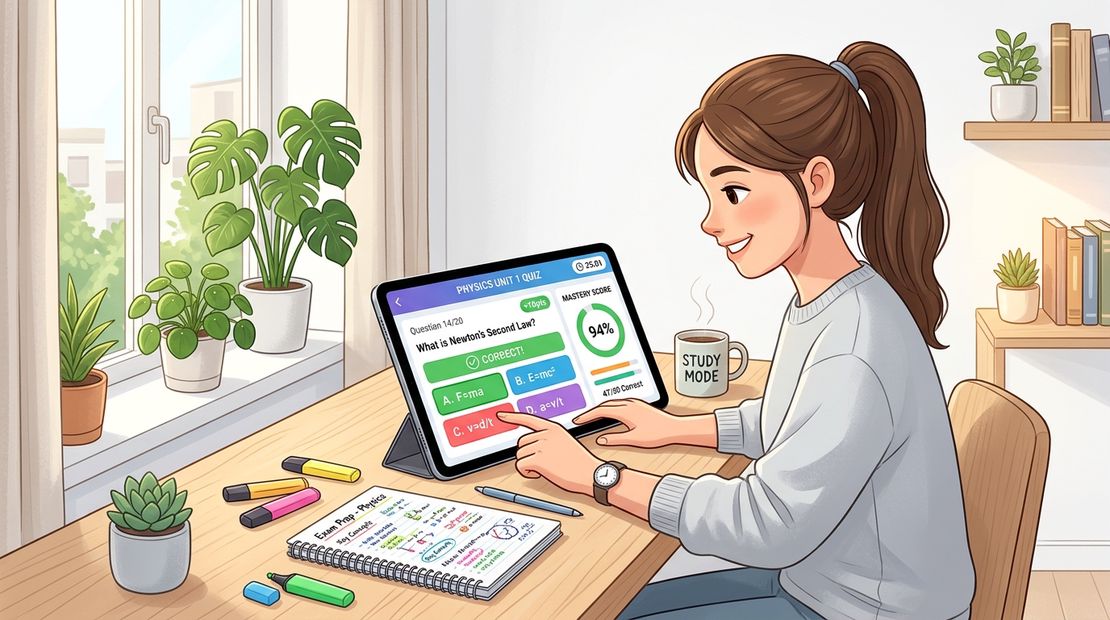
To build durable memory and perform under exam pressure, students must switch from passive review to active retrieval practice through practice quizzes.
The Science of Active Recall and the “Testing Effect”
The cognitive advantage of testing yourself is known in educational science as the testing effect.
When you read a sentence, information flows passively into your working memory. But when you are asked a question and forced to retrieve that fact from long-term memory, your brain must actively reconstruct neural connections.
Every successful retrieval signals to your brain that this specific piece of information is valuable, creating stronger synaptic pathways and making future recall significantly faster and more resistant to forgetting.
Furthermore, practice testing provides something passive reading never can: unforgiving, honest diagnostic feedback. It reveals what you actually know versus what you thought you knew while your book was open.
The 5-Step Practice Quiz Routine for High Marks
To maximize your revision efficiency, you do not need to study twelve hours a day. Instead, apply this structured 5-step routine using focused quizzes:
Step 1: Divide and Conquer with Topic-Wise Quizzes
Do not attempt full, comprehensive exam papers when you are first revising a subject. Trying to cover an entire textbook in one go leads to cognitive overload.
Instead, break your syllabus down into discrete modules or subtopics (for example, Photosynthesis and Cellular Respiration in Biology or Quadratic Equations in Mathematics). Take a short 10-to-15 question quiz focused solely on that specific topic.
Step 2: Test Closed-Book First
Resist the temptation to keep notes or answer keys open beside you. When you glance at an answer after five seconds of thinking, you short-circuit the retrieval struggle.
Allow yourself to wrestle with challenging questions. Research shows that even the effortful struggle to recall an answer enhances retention once the correct explanation is reviewed.
Step 3: Conduct an “Error Diagnostic” Audit
The real learning happens after the quiz is completed. Review every question you answered incorrectly or guessed on. Group your errors into three distinct categories:
- Category A: Factual Recall Gaps — You simply forgot a definition, formula, or date. Action: Add this specific fact to a quick flashcard or revision sheet.
- Category B: Conceptual Misunderstanding — You remembered the rule, but misapplied the logic or theory. Action: Return to your textbook or teacher’s notes to review the underlying concept.
- Category C: Careless Reading / Slip-Ups — You knew the concept perfectly, but misread the prompt (e.g., missed the word “NOT” in the question stem). Action: Practice highlighting key instruction words in future questions.
Step 4: Leverage Spaced Repetition Intervals
Memory degrades predictably along what psychologist Hermann Ebbinghaus described as the Forgetting Curve. If you practice a quiz on Monday and score 80%, your retention will decline over the following days unless you interrupt that decay.
Schedule your topic quizzes at expanding intervals:
- Day 1: Initial study session and first practice quiz.
- Day 3: Re-test missed questions and related variations.
- Day 7: Re-test the entire topic set to solidify long-term retention.
- Day 21: Final quick refresh before the major examination.
Step 5: Simulate Real Exam Conditions with Timed Mode
Knowledge is only half the battle during high-stakes exams; pacing and stress management make up the rest.
Two weeks before your official exams, transition to timed practice tests. Set a strict countdown clock, sit in a quiet room without distractions or phones, and complete the test in one sitting. This builds test stamina and eliminates the test anxiety that plagues students when the clock starts ticking.
A Quick Comparison: Study Methods Ranked by Retention
| Revision Technique | Cognitive Engagement | Retention After 1 Week | Typical Pitfall |
|---|---|---|---|
| Re-reading notes | Low (Passive) | ~15–20% | False sense of mastery (“I recognize this, so I know it”). |
| Highlighting text | Very Low (Passive) | ~10–15% | Colors the page without engaging the brain’s retrieval pathways. |
| Summarizing notes | Moderate | ~30–40% | Often turns into mindless copying of textbook sentences. |
| Practice Quizzes (Active Recall) | High (Active) | 75–85% | Requires real mental effort; uncovers uncomfortable knowledge gaps. |
How Evalumax Makes This Routine Effortless
Executing this structured revision routine manually with physical past papers and answer sheets can be time-consuming. This is why Evalumax was created.
Evalumax is tailored specifically around the principles of active retrieval and cognitive feedback:
- Instant, Granular Explanations: When you submit an answer, you do not just see “Correct” or “Incorrect.” Evalumax provides clear, contextual explanations that teach the reasoning behind the right choice.
- Topic-Wise Categorization: Pick the exact subject and chapter you want to strengthen without sifting through mixed exam papers.
- Automated Progress Analytics: Evalumax tracks your accuracy across topics, visually highlighting areas where your mastery score is lagging so you know exactly where to direct your study time.
- Mobile-Friendly Practice: Turn short snippets of spare time—such as bus rides or study halls—into powerful 10-minute revision sessions.
Final Advice for Exam Day
Studying effectively is not about working yourself to exhaustion; it is about respecting how human memory works. By trading passive textbook skimming for consistent, low-stakes quiz practice, you turn fragile facts into rock-solid confidence.
Ready to put these strategies into practice? Explore the Evalumax platform and try our interactive demo.